Russia bans a prominent LGBTQ+ rights group as extremist in a new blow to the beleaguered community

A court in Russia on Tuesday designated a prominent LGBTQ+ rights group as an extremist organization, the latest blow to the country's beleaguered community that has faced an intensified crackdown in recent years under President Vladimir Putin.

Associated Press

In a hearing that took place behind closed doors, the St. Petersburg City Court banned the Coming Out group as "extremist." The authorities did not reveal any details of the lawsuit filed last month by Russia's Justice Ministry and classified as secret.

The group, which now operates from abroad, said it will continue to help LGBTQ+ people in Russia and beyond, and fight for their rights despite the ruling.

"We have been preparing for this development for a long time. We enhanced security, developed sustainable work formats and continue to act responsibly, first and foremost for those who count on us," Coming Out said in an online statement.

"Today it is especially important not to give into fear and not to be alone. Our community is stronger than any labels, and history has proven that."

Coming Out is the first LGBTQ+ rights group to be designated since the 2023 Supreme Court ruling that effectively banned any LGBTQ+ activism. Similar lawsuits have been filed against two other LGBTQ+ rights groups, with courts in St. Petersburg and the Samara region still to rule on them.

Russia's LGBTQ+ community has been under legal and public pressure for over a decade, but especially since the Kremlin invaded Ukraine four years ago. Putin has argued that the war in Ukraine is a proxy battle with the West, which he says aims to destroy Russia and its "traditional family values" by pushing for LGBTQ+ rights.

Advertisement

Any depiction of gay and transgender people that portrays them in a positive or even neutral light has been banned ever since. Gender-affirming medical care and changing one's gender in official documents are prohibited.

In November 2023, Russia's Supreme Court declared what the government called "the international LGBT movement" to be an extremist organization, exposing anyone involved with that community to prosecution and potential imprisonment.

Days after the ruling, the community was rattled by news of police raiding gay bars, nightclubs and venues that hosted drag shows in Moscow, St. Petersburg and other cities. Criminal cases on the charges of involvement with the "LGBT movement" have followed, and some people have faced fines for displaying what the authorities determined to be "extremist" symbols such as a rainbow flag.

The Russian authorities are seeking to make the LGBTQ+ community "as vulnerable, as lonely as possible," said Denis Oleinik, executive director of the Coming Out LGBTQ+ rights group.

The group, formerly based in Russia's second-largest city of St. Petersburg, has been operating entirely from abroad since the full-scale invasion of Ukraine. It no longer offers support groups or offline activities, but still provides psychological and legal support remotely. It also works with international organizations in advocating for LGBTQ+ rights in Russia and for helping those fleeing the country, Oleinik told The Associated Press in February.

The ruling makes it unsafe for people to share any Coming Out content publicly or for anyone inside Russia or who travels there to donate money to the group, he said.

The "extremist" designation also sometimes scares people away from reaching out for help, as well as other rights groups or media outlets from working with them, Oleinik said. There also might be risks for relatives of activists who speak openly in public.

But otherwise, "we can provide help, and receiving our help is also allowed," he said.

Russia bans a prominent LGBTQ+ rights group as extremist in a new blow to the beleaguered community

A court in Russia on Tuesday designated a prominent LGBTQ+ rights group as an extremist organization, the latest blow to ...
State Department Urges Americans to Leave Middle East Immediately

The State Department has urged Americans across the Middle East to leave the region immediately due to "serious safety risks" posed by the U.S. and Israel's war with Iran.

Time

Theadvisory, posted on Monday afternoon, covers Bahrain, Egypt, Iran, Iraq, Israel, the West Bank, Gaza, Jordan, Kuwait, Lebanon, Oman, Qatar, Saudi Arabia, Syria, the United Arab Emirates, and Yemen. The State Department urges U.S. citizens in these areas to depart "using available commercial transportation."

"Our number one priority is the safety and security of American citizens everywhere in the world," Secretary of State Marco Rubio said in avideoposted on social media in light of what he called "cowardly attacks" by Iran on Gulf states.

Rubio urged U.S. citizens to register with the Smart Traveler Enrollment Program and monitor security updates from the State Department via its WhatsApp channel and social media. He added that the department has surged personnel and resources to provide Americans with safety and security information after the U.S. and Israel launched attacks on Iran on Saturday, which Iran has responded to with missile and drone strikes across the region.

The security update came before the U.S. Embassy in Saudi Arabia was hit in a suspected Iranian drone attack early Tuesday. There have been no reported casualties or injuries from the attack so far, sources toldCNN. The Saudi Ministry of Defence said it caused "limited fire and minor material damages." The U.S. Embassy in Riyadhissueda "shelter in place" notice to Americans in Saudi Arabia on Tuesday. When asked about how the U.S. will respond to the drone attack, President Donald Trumpsaid, "you'll find out soon."

Iran's retaliatory attacks have broadened since the U.S. and Israelbombed Iranandassassinatedits Supreme LeaderAyatollah Ali Khameneiover the weekend. Hundreds of people, includingmore than 100 children, in Iran were killed in ongoing U.S.-Israeli attacks, according to humanitarian organization Red Crescent. Iran initially retaliated with attacks on U.S. military bases in the Middle East, which has so far resulted in thedeaths of six American soldiers. Suspected Iranian strikes, including intercepted projectiles, alsoappeared to hit civilian areasof several Gulf states, includingSaudi Arabia's largest oil refineryand aluxury hotel in Dubai, killingmore than a dozenpeople across the region.

Read More:After Khamenei, Who Could Lead Iran Next?

On Tuesday, Iran's Islamic Revolutionary Guard Corps said on Telegram that it was beginning to target "American political centers" in the Middle East, and that "the explosion at the Washington embassy in Riyadh, the capital of Saudi Arabia, was a move in this direction." The U.S. Embassy in Kuwait was alsohitin suspected Iranian attacks on Sunday and Monday.

The conflict has also widened as Israel and Hezbollah, an Iranian-backed paramilitary in Lebanon, exchanged attacks on Monday and Tuesday. IsraelbombedBeirut again on Tuesday afterkilling at least 31 peopleinstrikeson Monday, while the Israeli Air Force said itinterceptedtwo drones from the direction of Lebanon early Tuesday after an initial attack by Hezbollah on an Israeli military base in retaliation for the assassination of Khamenei. Lebanese President Joseph Aouncondemnedboth Hezbollah and Israel's attacks for "persisting in using Lebanon once again as a platform for proxy wars."

Trump and his Administration have indicated that the U.S. plans to continue its attacks on Iran. The President toldCNNon Monday morning that the "big wave" of U.S. attacks on Iran is yet to come. Rubio alsotoldreporters on Monday that "the hardest hits are yet to come from the U.S. military" and that the "next phase will be even more punishing on Iran than it is right now," signaling a more expansive campaign than the initial Operation Epic Fury. Trump on Mondaysaidhe would deploy U.S. troops "if necessary" although he said he "probably" would not have to. He alsocautionedthat there would "likely be more" American soldiers killed in the U.S. military mission, which hesuggestedcould last four weeks.

Advertisement

Read More:'It's As If I'm Dreaming': Iranians Recount the First Day of the War, and the Death of Khamenei

Limited commercial travel reopens

Severe travel disruptions in the Middle East may complicate efforts by Americans to leave the region, even as some commercial air travel reopened on Monday evening.

At least 11,000 flights departing from and arriving in the Middle East have been canceled since Saturday, according to aviation analytics firm Cirium. Several airlines also suspended services through the middle of this week. U.A.E. national carrier Etihad Airwayssuspendedregular scheduled services till 2 p.m. local time (5 a.m. E.T.) on Wednesday, while Dubai-based airline Emiratessuspendedregular scheduled services till further notice.

Some airlines, including Emirates and Etihad, resumed some ad-hoc departures on Monday evening, mainly for repatriations. At least 16 Etihad flights departed from Abu Dhabi on Monday evening, according to flight tracker Flightradar24. Emirates also said it would resume limited flights beginning Monday evening, prioritizing customers with earlier bookings and directly contacting those who are rebooked to travel on these flights. Budget carrier flydubai alsoresumeda limited number of flights on Monday evening.

"Some repositioning, cargo and repatriation flights may operate in coordination with UAE authorities and subject to strict operational and safety approvals," Etihad said.

Dubai Airportssaidthat limited flights have been allowed to operate from Dubai International—the Middle East's biggest travel hub—and Dubai World Central, but it urged passengers not to go to the airport unless directly contacted by an airline.

Qatar's airspace remains closed, suspending all flights to and from Doha. Qatar's national carrier Qatar Airwayssaidin an update on Monday that all flight operations remain temporarily suspended until Qatari airspace is safely reopened. It said it will provide another update on Tuesday morning.

The airspaces ofIran,Iraq,Bahrain, andKuwaitremained closed as of Monday night, suspending all flights to and from those countries. Israel said it ispreparing to gradually reopenits airspace next week.JordanandSyriaalso partially closed their airspaces. Egypt said itsairspace is fully operational, while Egyptian airlines temporarily suspended services to certain cities. Dozens of flights havereroutedthrough Egypt, Turkey, Oman, and Saudi Arabia, which kept most of their airspaces open, although flights bound for Riyadh have held or turned back after reports of explosions, according toFlightradar24.

How many Americans are affected?

Exact numbers are unclear, but there are roughly hundreds of thousands of Americans living across the Middle East, which could put further strain on the limited available commercial travel. Most live in Israel, with 600,000 Americans there prior to Oct. 7, 2023, according to theWashington Post. Around15,000 Americans lived in Qataras of 2015,30,000 in Kuwaitas of 2020,50,000 in the U.A.E.as of 2015,80,000 in Saudi Arabiaas of 2022, and43,000 in Lebanonas of 2023. At least1,000 Americans and family members of Americansresided in and wished to depart Gaza in October 2023, according to a State Department briefing at the time, while around45,000 to 60,000 Palestinian Americanslived in the West Bank, Reuters reported in July 2023. Another60,000 live in Egypt, which has not been hit in attacks but is covered by the State Department's security update.

These figures do not include the number of tourists, for which there is limited available data; there are also limited reliable figures for the number of Americans residing in other countries in the region. "U.S. citizens are not required to register their travel to a foreign country with us, so we cannot track how many U.S. citizens have gone to a specific country," a State Department spokesperson toldAxiosin 2023.

Other countries have also issued travel warnings for the region. The British government said it was sending rapid deployment teams to the Middle East to support British nationals in the region and "ensure that they can return home as swiftly and safely as possible," Prime Minister Keir Starmer said on Monday. The U.K.urgedBritish nationals in Bahrain, Israel, Kuwait, Palestine, Qatar, and the U.A.E. to register their presence and monitor travel guidance. More than 100,000 British nationals have registered their presence in the Middle East so far, according to theBBC.

Contact usatletters@time.com.

State Department Urges Americans to Leave Middle East Immediately

The State Department has urged Americans across the Middle East to leave the region immediately due to "serious safe...
Britain sends destroyer and helicopters with counter-drone tech to Cyprus

LONDON, March 3 (Reuters) - Britain is deploying HMS Dragon, an air defence destroyer, to Cyprus ‌after the runway of its Akrotiri base ‌there was hit by an Iranian-made drone.

Reuters

Prime Minister Keir Starmer said ​on Tuesday he was sending the naval vessel along with helicopters with counter-drone capabilities to the region, as the conflict in the Middle East intensifies.

France and ‌Greece said they ⁠would also send anti-missile and anti-drone systems after the British base on the island ⁠was hit on Monday.

Advertisement

"The UK is fully committed to the security of Cyprus and British military personnel ​based there," ​Starmer said in a ​post on X, adding ‌that he had spoken with Cypriot President Nikos Christodoulides about the move.

"We're continuing our defensive operations and I've just spoken with the President of Cyprus to let him know that we are sending helicopters ‌with counter drone capabilities and ​HMS Dragon is to be ​deployed to the ​region," the British prime minister said.

HMS ‌Dragon is a Type 45 ​air-defence destroyer equipped ​with the Sea Viper missile system and advanced radar designed to track and neutralise airborne ​threats, according to ‌the Royal Navy's website.

(Reporting by Sam Tabahriti, ​Sarah Young and Elizabeth Piper, editing by William ​James and Kate Holton)

Britain sends destroyer and helicopters with counter-drone tech to Cyprus

LONDON, March 3 (Reuters) - Britain is deploying HMS Dragon, an air defence destroyer, to Cyprus ‌after the runway of its...
UConn caps its 11th unbeaten regular season, but coach Geno Auriemma warns tougher March ahead

NEW YORK (AP) — UConn completed its 11th undefeated regular season with avictory over St. John'son Sunday night and is nine wins from repeating as national champion with a seventh perfect season.

Associated Press UConn head coach Geno Auriemma, center, instructs his team from the sideline during the second half of an NCAA college basketball game against St. John's, Sunday, March 1, 2026, in New York. (AP Photo/Angelina Katsanis) UConn guard Blanca Quinonez, left, puts her palm on the face of St. John's guard Ariel Little (3) during the first half of an NCAA college basketball game, Sunday, March 1, 2026, in New York. (AP Photo/Angelina Katsanis)

UConn St Johns Basketball

Despite winning by an average of nearly 38 points per game, coach Geno Auriemma insisted this season hasn't been as easy it's looked from the outside for theNo. 1 teamin the AP women's basketball Top 25. He also knows winning a 13th national championship won't be as easy as last season's title run.

"I do think when the NCAA Tournament begins, it certainly is not going to be as easy as we experienced it last season," he said. "I think somebody like Paige (Bueckers) can (take over the postseason). We have enough good players to have as good a chance as anybody else out there to win a national championship."

The Huskies (31-0), who have won 47 consecutive games, have two of the best players in college basketball in guard Azzi Fudd and forward Sarah Strong.

"Coach came in (the locker room), said he was proud of us," Strong said after the St. John's win. "We also have a lot to work on to get ready for the Big East Tournament, so just enjoy the win now and be ready to get back to work."

The top-seeded Huskies have a bye until the quarterfinals on Saturday. If they do win another Big East Tournament, they'll enter the NCAAs unbeaten for the first time since the 2017 and 2018 seasons. UConn lost in the Final Four both times in heartbreaking fashion on last-second shots.

"Generally, the best team usually wins the national championship, but not always," Auriemma said. "It's the team who comes together at the right time. We've got a great group. We can do a lot of different things, and our defense has been really, really good all season long. So if we stay in that mindset, then we'll have a chance."

Advertisement

NET rating

UConn stillheld the top spotin the NET ratings Monday ahead of UCLA, South Carolina and Texas. The SEC has four of the top seven teams, while the Big Ten has seven of the first 17.

Richmond and Princeton are the top mid-major teams, coming in at 37 and 38, respectively.

The NET is just one tool the selection committee uses to figure out which teams make the NCAA Tournament and where they are seeded. It has predicted the winner pretty accurately since it first was used in 2021. Four of the five national champions were No. 1 in the NET on Selection Sunday.

NCAA reveal

The NCAA revealed for the second time this season its top 16 teams heading into the start of conference tournaments and UConn, UCLA, South Carolina and Texas were the No. 1 seeds. Fifteen of the 16 teams were the same as the first reveal, with the only exception being Minnesota entered and Ole Miss exited.

Games of the week

The Power Four conference tournaments begin with numerous potential Top 25 matchups in the Big Ten and SEC. If seedings hold, No. 5 Vanderbilt will face fourth-ranked Texas in the SEC semifinals with a potential 1-seed in the NCAA Tournament on the line.

Get poll alerts and updates on the AP Top 25 throughout the season. Sign uphere. AP women's college basketball:https://apnews.com/hub/ap-top-25-womens-college-basketball-pollandhttps://apnews.com/hub/womens-college-basketball

UConn caps its 11th unbeaten regular season, but coach Geno Auriemma warns tougher March ahead

NEW YORK (AP) — UConn completed its 11th undefeated regular season with avictory over St. John'son Sunday night and i...
Iran strikes the US Embassy in Saudi Arabia as war expands yet again

DUBAI, United Arab Emirates (AP) — Iranexpanded its targetsTuesday, striking the U.S. Embassy in Saudi Arabia as Washington began to pull many staff out of the Middle East. The U.S. and Israel battered Iran with airstrikes in what President Donald Trump suggested was just the start of a war that has severely disrupted the world's supply of oil and gas, international shipping, and air travel.

Associated Press

Theconflict escalated furtheron its fourth day, with Israel sending new ground troops into Lebanon and explosions ringing out in Iran's capital. Hundreds of people have been killed, the vast majority in Iran.

The spiraling nature of the war raised questions about when and how it would end. Trump said it could last four to five weeks — but that the U.S. was prepared to go longer. He seemed to leave open the possibility for more extensive U.S. military involvement, telling the New York Post on Monday that he wasnot ruling out the possibilityof boots on the ground.

Still, the administration's objectives remain unclear. The initial U.S.-Israeli strikes killed IranianSupreme Leader Ayatollah Ali Khameneiand Trump urged Iranians to overthrow their government.

Since then, however, senior administration officials have saidregime change was not the goal. Trump's initial announcement of the strikeslisted several grievances, from concerns about Iran's nuclear and missile programs to its leadership.

Iran hits the US Embassy in Riyadh and Washington pulls out staff

An attack from two drones on the U.S. Embassy in Riyadh caused a "limited fire," according to Saudi Arabia's Defense Ministry, and the embassy urged Americans to avoid the compound. It followed an attack on the U.S. Embassy in Kuwait. The embassy announced Tuesday it was closed until further notice.

The U.S. State Department ordered the evacuation of non-emergency personnel and family in Kuwait, Bahrain, Iraq, Qatar, Jordan and the United Arab Emirates. In addition, the U.S. has urged citizens to leave more than a dozen Middle Eastern countries, though with much of the airspace closed many remained stranded. Several other countries arranged evacuation flights for their citizens.

The U.S.-Israeli strikes have killed at least 787 people, according to the Iranian Red Crescent Society. In Israel, where Iranian missiles struck several locations, 11 people were killed. The Iranian-supported militant group Hezbollah has also attacked Israel, whose retaliatory strikes killed 52 people in Lebanon.

The U.S. military has confirmed six deaths of American service members. In addition, three people were killed in the United Arab Emirates, and one each in Kuwait and Bahrain.

Israel and US target nuclear facilities in Iran

Across Iran's capital, explosions rang out throughout the night into Tuesday, with aircraft heard overhead. Strikes caused two explosions at a broadcasting facility in Tehran, Iranian state TV said, adding that no one was injured.

The United Nations' nuclear watchdog, the International Atomic Energy Agency, said Iran's Natanz nuclear enrichment site had sustained "some recent damage," though there was "no radiological consequence expected."

The U.S. hit Natanz during the 12-day war in June, when Israeli and American strikesgreatly weakenedIran's nuclear program.

Israeli Prime Minister Benjamin Netanyahu maintained, however, that Iran was rebuilding "new sites, new places" underground for making atomic bombs. He offered no evidence to support his claim.

"We had to take the action now and we did," Netanyahu told Fox News Channel's "Hannity."

Iran has said it has not enriched uranium since June, though it has maintained its right to and says its nuclear program is peaceful.

Advertisement

Satellite photos analyzed by The Associated Press showed limited activity at two Iranian nuclear sites before the war. Analysts said Tehran was likely assessing damage from the 2025 strikes and possibly salvaging what remained.

It's not clear how long the war will last

The expansion of Iranian retaliation across the Gulf and the intensity of the Israeli and American attacks, Khamenei's killing and the lack of any apparent exit plan suggested the conflict could be prolonged.

Trump said Monday that operations are likely to last four to five weeks but that he was prepared "to go far longer than that." He later added the U.S. had a "virtually unlimited supply" of munitions.

"Wars can be fought 'forever,' and very successfully, using just these supplies," he wrote on social media.

The conflict is roiling business interests in the Mideast

Iran has hit many countriesdeemed safe havensin the Mideast in retaliation for the U.S.-Israeli strikes. Recent targets included two Amazon data centers in the United Arab Emirates and one in Bahrain. The centers in the UAE were hit, while a drone struck near the one Bahrain, causing damage, the company said.

Iran has also struck energy facilities in Qatar and Saudi Arabia, and attacked several ships in the Strait of Hormuz, the narrow mouth of the Persian Gulf through which a fifth of all oil traded passes, sending global oil and natural gas prices soaring.

"The Strait of Hormuz is closed," declared Iranian Brig. Gen. Ebrahim Jabbari, an adviser to the paramilitary Revolutionary Guard, vowing that any ships that passed through it would be set on fire.

Qatari Foreign Ministry spokesman Majed Al Ansari vowed that Iranian attacks on the gas-rich country "will not go unanswered."

Israel sends troops into Lebanon

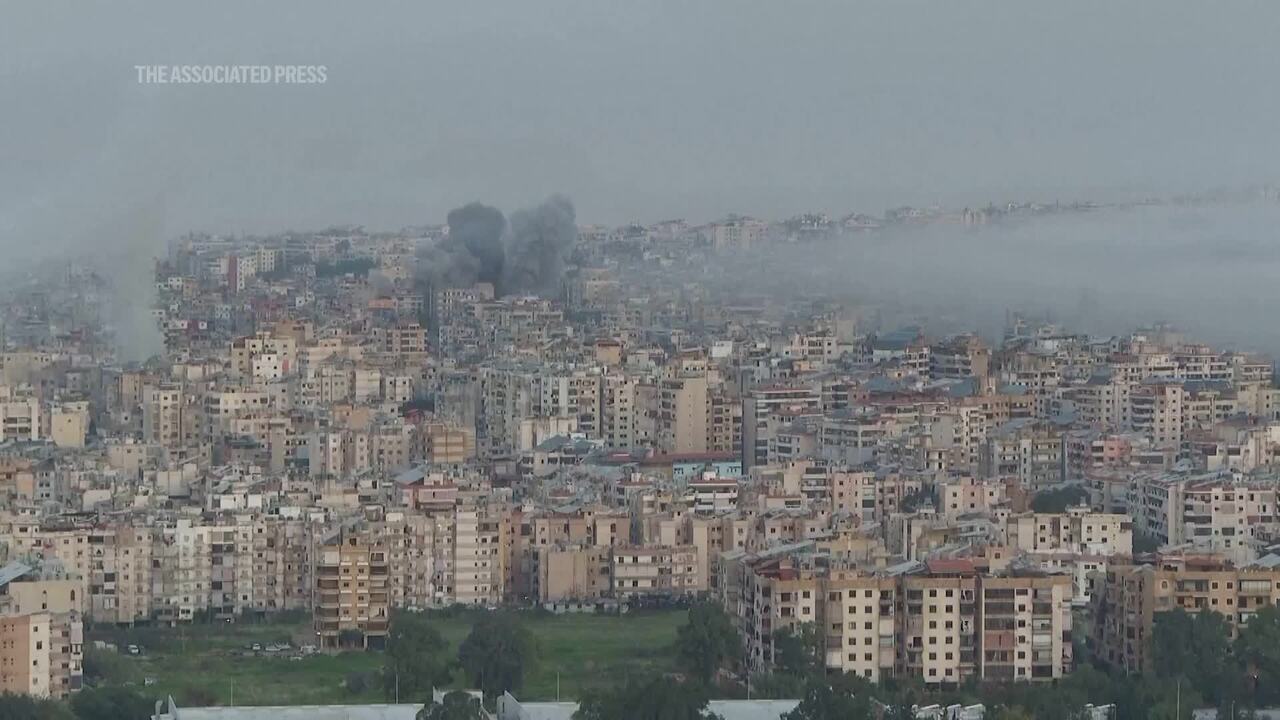
The conflict has spread to Lebanon, where Hezbollah fired missiles at Israel on Monday, prompting Israel to retaliate.

On Tuesday, the Israeli military hit Beirut with more airstrikes and said it had moved additional troops into southern Lebanon and taken new positions on several strategic points close to the border.

The U.N. peacekeeping force in Lebanon later said its peacekeepers saw Israeli troops going into and then out of Lebanon. But Israel's army said its troops are still operating in Lebanon.

This story has been updated to clarify that more than one drone hit the U.S. Embassy in Saudi Arabia. Some instances referred to just one drone.

Becatoros reported from Athens, Greece, and Magdy from Cairo. Konstantin Toropin in Washington, David Rising in Bangkok, Melanie Lidman in Tel Aviv, Israel, Hallie Golden in Seattle, and Giovanna Dell'Orto in Miami contributed to this report.

Iran strikes the US Embassy in Saudi Arabia as war expands yet again

DUBAI, United Arab Emirates (AP) — Iranexpanded its targetsTuesday, striking the U.S. Embassy in Saudi Arabia as Washingt...


MON SEVEN © 2015 | Distributed By My Blogger Themes | Designed By Templateism.com