Stories of survival emerge from deadly New York airport collision as officials investigate its cause

NEW YORK (AP) — Moments after an Air Canada jetcollided at high speed with a fire truckat New York's LaGuardia Airport, killing the pilots and hurling a flight attendant from the aircraft, the passengers took their escape into their own hands.

Associated Press Officials investigate the site, Monday, March 23, 2026, where an Air Canada jet came to rest after colliding with a Port Authority firetruck at LaGuardia Airport, shortly after landing Sunday night in New York. (AP Photo/Seth Wenig) An Air Canada jet and Port Authority fire truck sit on the runway at LaGuardia Airport, Monday, March 23, 2026, after colliding with each other after the jet landed Sunday night in New York. (AP Photo/Seth Wenig) An Air Canada Jet sits on the runway at LaGuardia Airport, Monday, March 23, 2026, after colliding with a Port Authority aircraft rescue and firefighting vehicle in New York. (AP Photo/Ryan Murphy) Department of Transportation Secretary Sean Duffy speaks during a news conference at LaGuardia Airport, Monday, March 23, 2026, after an Air Canada jet collided the night before with a Port Authority firetruck shortly after landing in New York. (AP Photo/Seth Wenig) A map showing LaGuardia Airport, New York. (AP Digital Embed)

APTOPIX LaGuardia Crash

With the smell of fuel in the air and debris dangling from the obliterated cockpit, passengers tore open emergency exit doors, jumped off the plane's wings and then turned around to catch others coming up behind them, some bleeding or with head wounds.

"Strangely enough, I wasn't scared or panicked. On the contrary, I think most of us were pretty aware of what happened," said passenger Clément Lelièvre. "So we all went outside; we got other people out."

About 40 passengers and crew members on the regional jet from Montreal, and two people from the fire truck, were taken to hospitals. Some suffered serious injuries, but by Monday morning, most had been released, and others walked away without needing treatment.

As investigators continued delving Tuesday into what caused thecatastrophic wreck, stories of survival also emerged — including that of the flight attendant, found injured but alive outside the aircraft.

Lelièvre credited the pilots' "incredible reflexes" with saving lives. The pilots braked extremely hard just as the plane touched down, he said.

The collision late Sunday came after the fire truck was given permission to check on another plane that had aborted its takeoff after reporting an odor on board and started crossing the tarmac. An air traffic controller can be heard on airport communications frantically telling the fire truck to stop.

Roughly 20 minutes later, the controller appears to blame himself. "We were dealing with an emergency earlier," the controller said. "I messed up."

A key for investigators will be examining coordination of the airport's air traffic and ground traffic at the time of the crash, said Mary Schiavo, a former Department of Transportation Inspector General.

Transportation Secretary Sean Duffy said LaGuardia is "well-staffed" but faces a shortage of controllers.

The runway where the crash happened is likely to be closed for "days" during the investigation, Jennifer Homendy, chair of the National Transportation Safety Board, which is leading the investigation, said at a news conference Monday. Investigators need to sift through a lot of debris, she said.

Authorities recovered the plane's cockpit and flight data recorders by cutting a hole in the aircraft's roof and then drove them to the NTSB lab in Washington for analysis, Homendy said.

Advertisement

It was too early in the investigation to answer many questions about the accident, but more information was expected to be released Tuesday, she said.

The crash shut down LaGuardia — the New York region's third busiest hub — during what was already amessy time at U.S. airportsbecause of a partial government shutdown.

Flights resumed Monday afternoon on one runway and with lengthy delays. The shutdown caused some disruptions at other airports, too, especially for Delta, which has a major presence at LaGuardia.

There were 72 passengers and four crew members aboard the Jazz Aviation flight operating on behalf of Air Canada, according to the airline. The flight originated at Montreal-Pierre Elliott Trudeau International Airport. Canada has also sent a team of investigators.

The pilot and copilot who died in the first fatal crash at LaGuardia in 34 years were both based out of Canada, said Kathryn Garcia, executive director of the Port Authority of New York and New Jersey, which operates the airport.

Jeannette Gagnier, the great aunt of one of the pilots, identified him as Antoine Forest, and said he always wanted to be a pilot.

Air traffic controllers are not impacted by the partial government shutdown that has causedlong delays at airport security checkpointsin recent days. They have been affected by past shutdowns.

The FAA has been chronically short on air traffic controllers for years.

LaGuardia is one of 35 major U.S. airports with an advanced surface surveillance system designed to help keep track of planes and vehicles crossing the airport.

An alarm heard in the background of the air traffic control audio was likely from the system and would have alerted the tower to the potential collision, Former FAA air traffic control chief Mike McCormick said.

FAA statisticsshow there were 1,636 runway incursions last year.

Associated Press reporters Michael R. Sisak, Anthony Izaguirre and Mae Anderson in New York; Rob Gillies in Toronto; Josh Funk in Omaha, Nebraska; Kathy McCormack in Concord, New Hampshire; and Hallie Golden in Seattle contributed.

Stories of survival emerge from deadly New York airport collision as officials investigate its cause

NEW YORK (AP) — Moments after an Air Canada jetcollided at high speed with a fire truckat New York's LaGuardia Airpor...
Catholics may receive organ transplants from animals, Vatican says

By Joshua McElwee

Reuters

VATICAN CITY, March 24 (Reuters) - The Vatican said on Tuesday that Catholics can receive transplants ‌of animal tissues to address medical conditions, as ‌procedures involving genetically modified pig or cow organs continue to advance.

In an ​88-page document providing ethical guidelines for such transplants, the Vatican reaffirmed an earlier teaching and said the Church has no objection to such treatments, provided they follow best medical practices ‌and do not ⁠treat animals with cruelty.

"Catholic theology does not have preclusions, on a religious or ritual basis, ⁠in using any animal as a source of organs, tissues or cells for transplantation to human beings," the document said.

Advertisement

The ​text addressed ​xenotransplantation, or the transplanting of ​organs or tissues from ‌one species to another. The Vatican first greenlit such procedures in 2001, when they were in very early stages of development.

Animal organ transplants for human use are still rare. The first pig-to-human kidney transplant was carried out in the ‌United States in 2024.

The Vatican ​document, which was drafted with the ​help of doctors from ​Italy, the U.S. and the Netherlands, called ‌on scientists to pursue animal ​transplants in a ​manner that is "purposeful, proportionate and sustainable".

It also called on doctors to disclose the risks of animal transplants, ​including the probability ‌of rejection by a patient's immune system and the ​possibility of causing infection from microorganisms.

(Reporting by Joshua ​McElwee, editing by Andrei Khalip)

Catholics may receive organ transplants from animals, Vatican says

By Joshua McElwee VATICAN CITY, March 24 (Reuters) - The Vatican said on Tuesday that Catholics can receive tr...
Supreme Court to scrutinize former policy of turning away asylum seekers at southern border

The Supreme Court on Tuesday will consider the legality of a policy championed by President Donald Trump during his first term that prevented scores of migrants arriving at the southern border from starting the process of applying for asylum.

CNN The wall at the US-Mexico border is seen in Nogales, Arizona, on February 4, 2026. - Olivier Touron/AFP via Getty Images

The policy was rolled out under President Barack Obama, formalized by Trump and rescinded in 2021 under President Joe Biden, but the Justice Department has continued to defend it in court over the years. Trump's solicitor general, D. John Sauer, recently told the justices the measure is a "critical tool for addressing border surges and preventing overcrowding at ports of entry."

The case is one of several before the high court this session testing controversial immigration policies that Trump wants justices to approve. Next month, the nine will review an order he issued last year that sought to end birthright citizenship, as well as hisefforts to end temporary deportation protectionsfor Haitians and Syrians.

Officials have not said publicly whether they plan to revive the asylum policy, known as "metering," which was introduced during the waning weeks of the Obama administration and fleshed out by Trump in 2018.

But the current administration's decision to continue backing it in court underscores its desire to keep the policy as a backup avenue to stem the flow of migrants at the border as other restrictive measures face challenges in court.

"The Supreme Court isn't supposed to decide hypothetical questions, which is why it's weird that it agreed to take up this appeal in the first place," said Steve Vladeck, CNN Supreme Court analyst and professor at Georgetown University Law Center.

"Whether or not the Trump administration wants to restart this particular policy, the fact that it isn't currently in effect ought to be fatal to the Supreme Court's power to decide this case, one way or the other," he added.

Under federal law, the government must process a migrant who presents at a port of entry and is fleeing political, racial or religious persecution in their home country. A migrant covered under that requirement is defined as someone "who is physically present in the United States or who arrives in the United States."

But the metering policy enabled federal agents stationed at the border to turn back such asylum seekers before they ever stepped foot on US soil. The policy, which aimed to help officials manage the number of migrants seeking safe haven in recent years, gave workers at ports the flexibility to let in migrants if they determined there was "sufficient space and resources to process them."

The question before the justices on Tuesday is relatively straightforward: Is a migrant who is stopped by federal agents on the Mexican side of the border covered under the law that requires officials to begin passing them through the asylum process?

The administration contends the answer is "no."

"The ordinary meaning of 'arrives in' refers to entering a specified place, not just coming close to it. An alien who is stopped in Mexico does not arrive in the United States," Sauer wrote in court papers. "The phrase 'arrives in the United States' does not even plausibly, much less clearly, cover aliens in Mexico."

But an immigrant rights group and more than a dozen individuals who represent a class of migrants that challenged the policy have countered that the answer is an unequivocal "yes."

"Congress's use of the present tense" in the statute shows that lawmakers wanted the law's "mandates to apply not only to those who have arrived, but also to those who are attempting to step over the border," the policy's legal foes said in written arguments submitted ahead of Tuesday's hearing.

"If Congress wanted the law to cover only noncitizens who had arrived, it would have said so," their lawyers told the justices.

Lower courts sided against the policy

When Obama rolled out the first iteration of the policy in 2016, officials at the border were reeling from a surge of Haitian asylum seekers, which had overwhelmed their ability to manage the situation.

But after Trump took office and formalized a more robust version of the policy, the government was taken to court by Al Otro Lado, a nonprofit legal services organization for asylum seekers, and the 13 individual challengers.

Advertisement

A federal judge in California ruled the policy was unlawful and certified a class of individuals to be shielded from it.

In a divided decision in 2024, the 9th US Circuit Court of Appeals affirmed that ruling, concluding the policy ran afoul of the federal law.

"The phrase 'physically present in the United States' encompasses noncitizens within our borders, and the phrase 'arrives in the United States' encompasses those who encounter officials at the border, whichever side of the border they are standing on," Judge Michelle Friedland wrote in the majority decision.

Notably, Friedland, who was joined by fellow Obama appointee John Owens, stressed that the ruling left the government "with wide latitude and flexibility to carry out its duties at the border."

Federal laws, Friedland said, "require border officials to inspect noncitizens seeking asylum at the border, and the metering policy withheld that duty."

A connection to the past

Policy decisions on managing asylum seekers at the southern border have changed frequently in recent years.

Biden's solution was to have migrants use a phone app to schedule appointments with federal agents at a legal port of entry. They then waited outside the US until they could be inspected by an immigration officer and begin the asylum process.

Though Biden rolled back the metering policy in November 2021, his Justice Department continued defending its legality in court, telling the 9th Circuit that the policy was "reasonably based on demonstrated capacity constraints."

Trump ended the Biden-era appointment policy after returning to office last year, and he shut down the border for asylum seekers. That decision is at the center of a legal challenge making its way through the federal courts in Washington, DC.

When the metering policy was in place, it frustrated the ability of tens of thousands of migrants to move forward in seeking asylum, according to the Strauss Center at the University of Texas at Austin.

Turning those people back, the policy's challengers told the high court, "quickly created a humanitarian crisis in Mexico."

"As CBP continued to refuse to inspect or process asylum seekers, many of those turned away found themselves living in makeshift camps on the Mexican side of the border," they told the justices in court papers. "The growing bottleneck of asylum seekers turned back by (Customs and Border Patrol) waited near the ports for weeks and then months without reliable food sources, shelter, or safety."

Some, they said, "attempted instead to enter the United States between ports and died while crossing the Rio Grande or the Sonoran Desert."

That reality has drawn comparisons to a World War II-era episode during which the US turned away the MS St. Louis, a ship ferrying nearly 1,000 Jewish refugees fleeing Europe in 1939.

HIAS, formerly known as the Hebrew Immigrants Aid Society, told the justices in court papers that the metering policy "creates a legal no man's land" that puts the safety of asylum seekers at risk.

"People are left in limbo in dangerous border towns, unable to access the process our laws guarantee to those who arrive at a port of entry and present themselves to US officials standing on US soil," the group said in its friend-of-the-court brief. "It is the kind of purgatory experienced by the St. Louis passengers and that Congress eradicated for those who reach a port of entry: safety visible but unreachable."

For more CNN news and newsletters create an account atCNN.com

Supreme Court to scrutinize former policy of turning away asylum seekers at southern border

The Supreme Court on Tuesday will consider the legality of a policy championed by President Donald Trump during his first...
Tiger Woods to play TGL match final for his Jupiter Links with a title on the line

PALM BEACH GARDENS, Fla. (AP) — Tiger Woods has put himself into the lineup Tuesday night for his Jupiter Links team in the TGL final, waiting until the last day to make his first appearance in the tech-infused indoor league.

Associated Press

Woods has been at every match as a captain and a cheerleader while recovering from a seventh back surgery last October. He has gone more than a year since competing anywhere because of a ruptured Achilles tendon in March 2025.

Jupiter Links lost the opening match Monday night in the best-of-3 final against Los Angeles and now has to win two matches at the SoFi Center.

Wood said last week after Jupiter won to reach the finals he has been trying to play the matches.

"I've been trying to come back. But it just hasn't worked out that way," he said. "I've had a bad run of injuries last year. I think it's been a year and a few days since I blew out my Achilles. And so then I've had two back operations. So it's been a little rough go. But the guys here, this team, we have so much fun, I really don't want to screw up the lineup, I just want these guys to keep playing."

Advertisement

Woods will be replacing Kevin Kisner, who was on the losing end of the decisive hole in singles. Jupiter had a 5-4 lead when Los Angeles threw the hammer — meaning the hole was worth two points — for the par-5 closing hole.

Sahith Theegala had the length to easily reach the green in two and set up a two-putt birdie. Kisner, who has spent most of March in the booth for NBC's coverage of the PGA Tour, drove into the rough, laid up in the rough and hit wedge that didn't quite reach the green. His birdie chip from 20 feet to tie the hole — and win the match — narrowly missed to the left.

Woods joins Tom Kim and Max Homa for Jupiter Links. Akshay Bhatia had been filling in as an alternate, but he is in New Delhi this week on a sponsor invitation to play the Hero Indian Open.

AP golf:https://apnews.com/hub/golf

Tiger Woods to play TGL match final for his Jupiter Links with a title on the line

PALM BEACH GARDENS, Fla. (AP) — Tiger Woods has put himself into the lineup Tuesday night for his Jupiter Links team in t...
MLB Opening Day 2026: How different are all 30 teams compared to last season?

Another offseason has come and gone, and another marathon of an MLB season is staring us in the face. To close the book on the winter and set the stage for the season ahead, it's time to conduct my annual exercise of evaluating all 30 rosters based on how much they changed since last year. This is not about determining whether a squad is better or worse, simply whether they are different.

Yahoo Sports

The methodology is simple and remains the same as it wasin 2024and2025. Tally every plate appearance taken and inning pitched for each team last season. If the players behind those plate appearances and innings are still in the organization, they qualify as "returning."

For example, Francisco Lindor recorded an MLB-leading 732 plate appearances in 2025, roughly 11.8% of his team's trips to the batter's box. He is still on the Mets, so his plate appearances are returning. The same cannot be said about Pete Alonso (709 plate appearances), Brandon Nimmo (652) or Jeff McNeil (462). By subtracting that trio's playing time from the Mets' returning total and comparing the results to teams across the league, we can arrive at an objective measure of how different the new-look Mets are from the 2025 squad, rather than merely marveling at the chaotic roster shuffling that took place in Queens this winter.

Draft your Yahoo Fantasy Baseball team for the 2026 MLB Season

In other words, this is a straightforward avenue to assess roster turnover, a vehicle for answering a popular offseason question: Which teams ran it back, and which teams shook things up?

This exercise also helps capture which fan bases will be adjusting to a larger portion of fresh faces on their teams in 2026 and which will be watching rosters that are largely unchanged.

A crucial caveat to keep in mind: Returning totals do not account for injuries, which can occasionally result in misleading tallies, especially on the mound. Pitchers who delivered a sizable workload last year but are currently injured — such as Pablo López in Minnesota or Spencer Schwellenbach, Hurston Waldrep and Spencer Strider in Atlanta — are still considered part of the team's "returning" total, even if they won't be available for most or all of the coming season. This dynamic is especially relevant in the case of the Braves, who technically have retained the second-highest percentage of 2025 innings, but absences could open the door for new arms to cover innings in 2026.

But enough preamble, let's get to the data and highlight a few teams whose totals stand out on both ends of the spectrum:
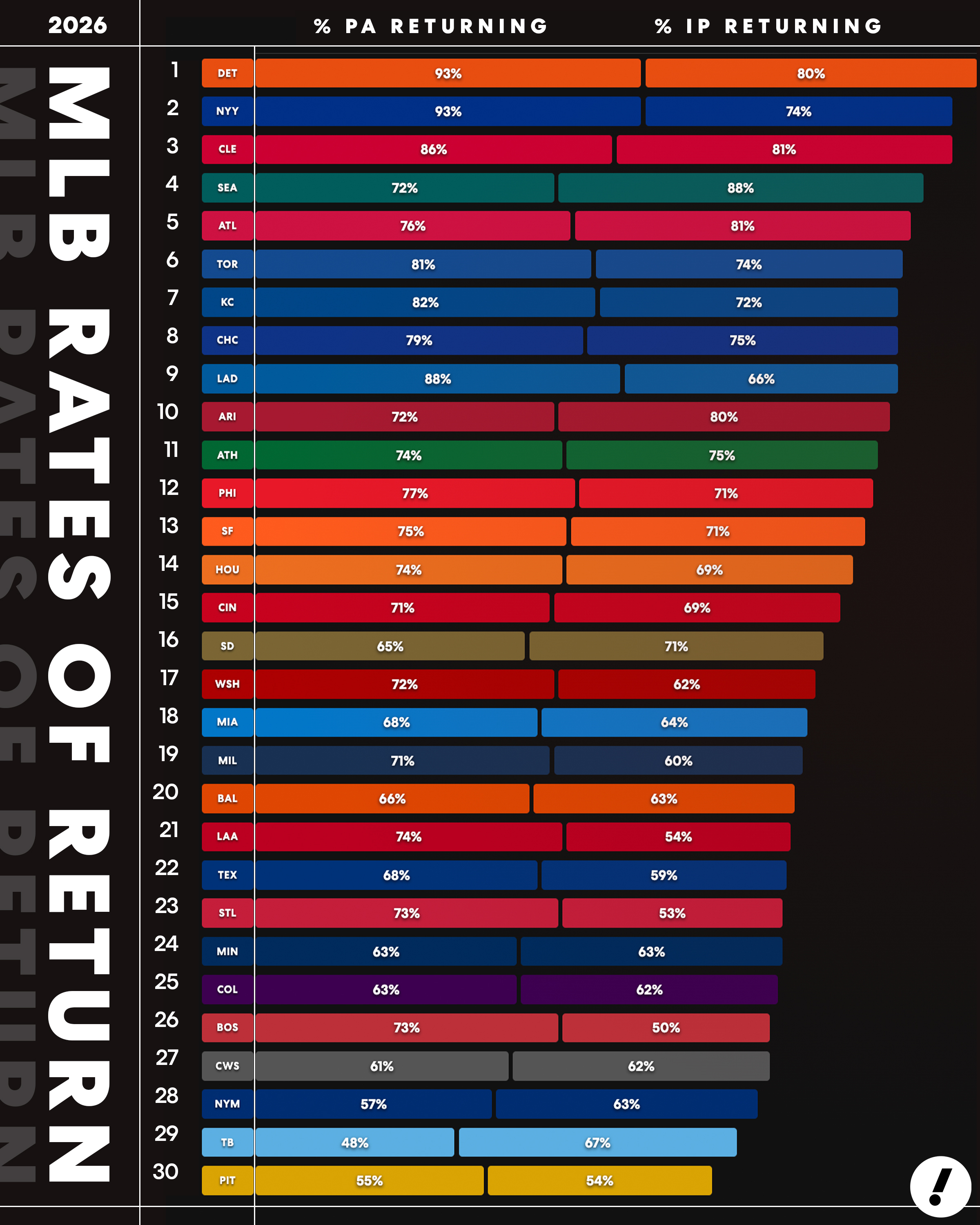
The Tigers are running it back in 2026. The Pirates are very much not. (Data compiled on March 20.)

New York Mets

Welcome to Extreme Makeover: David Stearns Edition. The Mets epitomize this exercise, having overhauled their roster in response to a dismally disappointing 2025 that the front office and ownership evidently viewed as cause for a total refresh. That included letting mainstays Alonso and Edwin Díaz walk in free agency and jettisoning the two other longest-tenured players, Nimmo and McNeil, via trade. After the dramatic subtraction, the Mets slowly restocked their offense with Jorge Polanco, Bo Bichette and Luis Robert Jr., plus Marcus Semien, who arrived from Texas in the Nimmo swap. Franchise anchors Francisco Lindor and Juan Soto remain in place, but the lineup around them looks a whole lot different entering 2026.

There's a bit more continuity on the mound, with New York's top three pitchers by innings last season — David Peterson, Clay Holmes and Kodai Senga — still in the fold. But the departures of Díaz, Griffin Canning, who ranked fourth in games started and innings last year, and Ryne Stanek, the Mets' most used reliever, necessitated some additions to the pitching staff. New York dealt two top prospects in Brandon Sproat and Jett Williams to land one of the best starting pitchers on the trade market in Freddy Peralta and spent real dough to snag a pair of high-leverage bullpen arms in Devin Williams and Luke Weaver. All together, it was a wild winter of roster reconstruction, closing the book on several lengthy and notable Mets tenures and starting new chapters for some high-profile fresh faces.

New York Yankees

Polar opposite of the Mets on the continuity spectrum are the New York Yankees, who spent the bulk of the offseason trying to keep their roster intact. This is a sharp contrast in strategy not only to their neighbors in Queens but also to the Yankees' own roster construction just a year ago. Entering 2025, coming off its first World Series berth since 2009, New York had the fourth-lowest percentage of plate appearances plus innings returning in MLB. That was primarily due to the departures of lineup regulars Juan Soto, Gleyber Torres, Alex Verdugo and Anthony Rizzo, plus some key innings-eaters in Nestor Cortes Jr. and Marcus Stroman.

The additions of Max Fried and Cody Bellinger, plus the emergence of homegrown impact players Ben Rice and Cam Schlittler, kept New York near the top of the American League in 2025, but an abrupt October exit against Toronto in the ALDS suggested another roster remix might be in order. Instead, general manager Brian Cashman spent the winter retaining a whopping six free agents, from starting outfielders Bellinger and breakout slugger Trent Grisham to bench bats Paul Goldschmidt and Amed Rosario to depth arms Ryan Yarbrough and Paul Blackburn. The most significant external addition was a new pitcher in Ryan Weathers, while Williams and Weaver bolted crosstown to join the Mets, putting a dent in the Yankees' returning total on the mound. But the Yanks rank second in returning bats behind only the Tigers, with their top 11 hitters by 2025 plate appearances still in the organization (Nos. 12 and 13, Oswald Peraza and DJ LeMahieu, are no longer around).

Advertisement

There seems to be some consternation within the fan base that running it back to this degree might not be the best plan. But Cashman seems unbothered by that perception, and there's reason to believe that with enough additional strides internally, the Yankees should be in the mix for another division title in 2026. It's also worth noting that the most exciting returning Yankee is one who didn't throw a pitch last season; that's ace Gerrit Cole, whose comeback from Tommy John surgery isn't captured in these calculations but is undoubtedly an enormous storyline in the Bronx.

Pittsburgh Pirates

It wasn't as flashy or as extreme as what the Mets did, but the Pirates are another club that was awfully busy reshaping the roster over the past few months, and the data conveys as much. Pittsburgh, of course, operates in a different universe than New York when it comes to spending, but the Pirates still managed to drastically alter their team through a series of trades and (relatively) aggressive expenditures in free agency. The general theme and goal of Pittsburgh's offseason was to balance out a roster that had a lot to like on the pitching side but was bereft of impact in the lineup.

In an effort to upgrade what was the worst offense in baseball by wRC+ in 2025, the Pirates acquired second-base slugger Brandon Lowe, signed two veteran mashers in Ryan O'Hearn and Marcell Ozuna and added to the outfield mix with speedster Jake Mangum and near-ready prospect Jhostynxon Garcia. This mix of quality hitters will backfill the at-bats vacated most notably by the beloved Andrew McCutchen, as well as Tommy Pham, Isiah Kiner-Falefa and Ke'Bryan Hayes; that quartet combined to log more than 1,800 plate appearances last season.

On the mound, the next wave of homegrown Pirates hurlers, headlined by top prospect Bubba Chandler, are expected to cover the frames that were handled last year by veteran Andrew Heaney and Bailey Falter before he was traded. Those two lefties ranked third and fourth in 2025 innings for Pittsburgh, while Mike Burrows (96 IP) and Johan Oviedo (40 1/3 IP) were also sent elsewhere in the quest for more bats.

Can this overhauled offense and an ascendant pitching staff led by Paul Skenes end the longest postseason drought in the National League? Can't wait to find out.

Bo Bichette and Ranger Suárez will be donning new uniforms on Opening Day. Jack Flaherty and José Ramírez will be in familiar colors.

Detroit Tigers

The only team with a higher rate of return than the Yankees, the Tigers sit atop the leaderboard due more to the nature of their roster than a concerted effort to retain free agents. The tone of the offseason was set early, when Detroit's two most prominent potential free agents chose to stay put: Jack Flaherty by exercising his player option and Gleyber Torres by accepting the qualifying offer. Reliever Kyle Finnegan, acquired at last year's trade deadline, followed by re-upping with the Tigers on a two-year deal in early December. Beyond that, the Tigers didn't have many key contributors hit the open market, and perhaps even more importantly, president of baseball operations Scott Harris opted to keep quiet on the trade front. That means a gigantic portion of the regulars from last season are still around, including the top 11 batters by plate appearances and the top seven pitchers by innings pitched.

At the plate, that continuity could be construed as a negative, considering how badly the offense tailed off down the stretch and into October, but promising reinforcements are on the way in the form of top prospect Kevin McGonigle. Meanwhile on the mound, many of the same arms are in place, but that doesn't mean they'll be tasked with covering nearly the same number of innings after Detroit added several big-name pitchers via free agency in frontline lefty Framber Valdez, old friend Justin Verlander and new closer Kenley Jansen. That Verlander — a legend in Detroit — counts as "fresh face" underscores how few new names Tigers fans will need to learn as the season begins. Whether Detroit should have upgraded its lineup more aggressively, rather than supercharging its pitching staff behind Tarik Skubal, will be an interesting what-if to monitor as the season unfolds.

Cleveland Guardians

The defending AL Central champions and the biggest benefactors of Detroit's second-half collapse last season, Cleveland also deployed the offseason strategy of changing very little. However, unlike the Tigers, who eventually splashed some cash around in free agency, Cleveland did nothing of the sort while remaining stingy on the trade market. That result is a total nothing-burger of an offseason outside of a few bullpen additions (Shawn Armstrong, Colin Holderman, Connor Brogdon) and a minor-league deal for veteran first baseman Rhys Hoskins.

The biggest move of Cleveland's winter was an extension for face-of-the-franchise José Ramírez. It's great for the Guardians to continue that player-team partnership, but it did nothing to change the fortunes of the team in the short term. Cleveland sure looked like it could use some more substantial upgrades on offense but instead stood largely pat, trusting that its deep group of young but unproven bats can grow together to form a more competent offense in 2026.

One important note regarding Cleveland's totals in the chart above: Its returning inningsdo notinclude the combined 136 innings thrown in 2025 by Emmanuel Clase and Luis Ortiz, who remain on the restricted list amid their alleged involvement in the gambling scandal that rocked baseball last summer. Although they technically remain in the Guardians' organization, both were recently moved to the unpaid non-disciplinary leave list as they await federal hearings. Including them as part of Cleveland's returning total feels misleading at this stage, considering the slim chance that either ever pitches in MLB again. Had Clase and Ortiz counted toward the Guardians' returning innings, that would've vault the team to the top of the overall rankings. Instead, the Guards slot in third, behind the Tigers and Yankees.

Boston Red Sox

Chief baseball officer Craig Breslow has been transacting up a storm since taking over in Boston, and this offseason was no different. It's no secret that the Red Sox intended to build around Alex Bregman after sending Rafael Devers to San Francisco in a midseason stunner of a trade, but Bregman instead said goodbye after one year in Boston, finding a better deal with the Cubs and leaving the Red Sox to pivot. That change of plans mostly centered on improving the pitching staff behind Garrett Crochet, upgrading significantly via free agency (Ranger Suárez) and trade (Sonny Gray, Johan Oviedo).

That might've seemed like a strange use of resources, considering Boston's pair of MLB-ready prospects in Payton Tolle and Connelly Early, but free-agent departures (Lucas Giolito, Walker Buehler, Justin Wilson, Sean Newcomb, Dustin May) and a series of trades (Hunter Dobbins, Brennan Bernardino, Richard Fitts, Kyle Harrison, Jordan Hicks) thinned out the pitching depth considerably, prompting those major adds on the mound. Boston also made moves to help replace Bregman's (and Devers') production, with Willson Contreras the biggest bat brought in and Caleb Durbin rounding out the infield mix after a standout rookie season with the Brewers.

Perhaps most remarkable about the Red Sox's placement in the rate of return rankings is how much lower they could've been, had they traded from their outfield surplus as many expected them to. A deal of Jarren Duran or Ceddanne Rafaela would've plummeted Boston down toward the bottom with Tampa Bay and Pittsburgh. Instead, Breslow opted to hold on to all of his outfielders and trust that they'll get the requisite at-bats to form a formidable lineup.

MLB Opening Day 2026: How different are all 30 teams compared to last season?

Another offseason has come and gone, and another marathon of an MLB season is staring us in the face. To close the book o...


MON SEVEN © 2015 | Distributed By My Blogger Themes | Designed By Templateism.com