College student shot and killed while walking with friends near campus

A Chicago college student was walking with friends near campus when an unknown suspect walked up to them and fatally shot her, authorities said.

USA TODAY

Police said they responded to a report of someone shot at about 1:30 a.m. on March 19. The 18-year-old victim was walking outside near Tobey Prinz Beach Park with a group of friends when an "unknown male offender" approached them. He "displayed a firearm" and shot in the direction of the group, the Chicago Police Department said in a statement. The victim was shot in the head and pronounced dead on the scene. Nobody else was injured, police said.

Detectives are "currently questioning a person of interest," the Chicago Police Department told USA TODAY in an update the morning of March 21.

The victim was identified as Sheridan Gorman, 18, by her hometown in Yorktown, New York. She was a student at Loyola University Chicago.

She was "loved by all who knew her," Yorktown Central School District Superintendent Dr. Ron Hattar said in a letter to district parents, reported theRockland/Westchester Journal News, part of the USA TODAY Network.

Advertisement

"On behalf of the Town of Yorktown, I, our municipal staff, and Town Board extend our deepest condolences to Sheridan's family in this time of profound loss," Yorktown Town Supervisor Ed Lachterman said on Facebook. "We pray that law enforcement will quickly apprehend the perpetrator of this heinous act."

Loyola University Chicago President Mark C. Reed said in a statement that the university is in close contact with law enforcement amid the investigation, and that there appears to be no ongoing threat to the campus community.

"This is a tragic loss, and our hearts go out to Sheridan's family, loved ones, and all who knew her," Reed said.

Gorman was a graduate of Yorktown High School and was a member of the girls' varsity bowling team while there, the town said.

"She was a ray of sunshine, and this darkness cannot diminish her light," the town said in a statement.

This article originally appeared on Rockland/Westchester Journal News:Chicago student shot and killed while walking with friends near campus

College student shot and killed while walking with friends near campus

A Chicago college student was walking with friends near campus when an unknown suspect walked up to them and fatally shot...
Tennessee plans rare execution of a woman. She's fighting back.

Christa Gail Pikewas just 18 years old when she committed a crime that dominated headlines for years: She tortured and murdered her romantic rival in Tennessee and later showed off a piece of the 19-year-old woman's skull to schoolmates.

USA TODAY

The killing in the woods of Knoxville demonstrated a brutality and callousness rarely seen in a woman, let alone one so young. Now 30 years later, Pike is back to making headlines as the state of Tennessee prepares to execute her.

Pike, who just turned 50 on March 10, is set to be executed by lethal injection about six months from now on Sept. 30 for the murder of 19-year-old Colleen Slemmer. On Jan. 12, 1995, Pike and two others lured Slemmer into the woods and carried out a ritualistic murder that lasted about an hour.

If the execution moves forward, Pike will be the first woman put to death in Tennesseein more than 200 yearsand only the19th woman executedin modern U.S. history.

She's now fighting back and suing the state to stop her execution.

Christa Gail Pike looks around as someone enters the courtroom where a hearing for a new trial for her was being held on Jan. 12, 2001.

Pike's attorneysfiled a lawsuitin a Tennessee court in January challenging the state's lethal execution method, arguing that it violates her religious beliefs and constitutional rights, and could cause her excessive pain. In response to Pike's arguments, the state says in a court filing on Thursday, March 19, that she hasn't presented any evidence that the lethal injection presents an unconstitutional risk to her and that death row inmates have never been guaranteed a pain-free execution.

During Pike's time behind bars, she has taken responsibility for the murder and has "changed drastically," she wrote in a 2023letter she wrote to The Tennessean− part of the USA TODAY Network.

"It sickens me now to think that someone as loving and compassionate as myself had the ability to commit such a crime," she wrote.

USA TODAY is looking at Pike's arguments for a reprieve from execution, what the state has to say about them and how the victim's mother feels.

What was Christa Gail Pike convicted of?

Christa Gail Pike and Colleen Slemmer were both students at the Knoxville Job Corps, a career-training program, when Pike began dating a 17-year-old boy in the program. She later came to fear that Slemmer was trying to steal him, prosecutors told jurors at trial.

Pike, her friend and the boyfriend, lured Slemmer away from the Job Corps center and into the woods before the attack, largely carried out by Pike over an hour-long period on Jan. 12, 1995, according to court records.

Pike later bragged about killing Slemmer, telling another student at the center that she had cut the teenager's throat six times with a box cutter, cut her back with a meat cleaver, carved a pentagram into her chest, and continued the violence even though Slemmer "begged" her to stop, according to court records.

Pike said she had "thrown a large piece of asphalt at the victim's head," believed to be a fatal blow, and kept a skull fragment, later showing it off to fellow students, court records say.

Pike was convicted of first-degree murder and sentenced to death. Pike's boyfriend, Tadaryl Shipp, was convicted of first-degree murder, sentenced to life in prison and recently was denied parole. Pike's friend, Shadolla Peterson − who prosecutors say kept watch during the attack − testified against Pike and was sentenced to probation.

Colleen Slemmer is pictured

Who is Christa Gail Pike?

Christa Gail Pike, 50, is the only woman on Tennessee's death row and has been living there for 30 years following her sentencing in April 1996. Pike and her mother, Carissa Hansen, sobbed uncontrollably in the courtroom during the sentencing, according to archived news reports.

Pike's trial attorneys had tried to mitigate her crimes by describing Pike as a cast-off child from a dysfunctional family who bounced between her divorced parents' houses depending on who was sick of her at the time, according to an archived news report in the Knoxville News-Sentinel, part of the USA TODAY Network.

Hansen told jurors that she was a bad mother who smoked pot with her daughter and even allowed Pike to have a live-in boyfriend at the age of 14. "I should be the one in her seat. I should be punished for her crime," Hansen said, according to the News-Sentinel.

Christa Gail Pike is pictured at a hearing on July 30, 2007, at the age of 31. Her attorneys were working to get her off of death row at the time.

A University of Tennessee police officer countered the sympathetic testimony, telling jurors that Pike returned to the scene of the crime after Slemmer's body had been found and "seemed amused."

"She was giggling," he testified, the newspaper said.

Pike's current attorneys arguethat had she been tried today, Pike never should have been sentenced to death because of her young age and mental illness at the time of the murder, and her disturbing history of being sexually abused as a child, starting before she could even talk. They believe she deserves life in prison without the possibility of parole.

On Pike's website, created by supporters who are arguing for her clemency, Pike says that she doesn't want to use her childhood trauma as an excuse for Slemmer's murder.

"There is no excuse for what I did ... I take full responsibility for my actions, and regret everything that happened that night," she says. "I only want my situation to be looked at now through the eyes of logic instead of anger and answered the question of if I deserve to die for a crime committed by three people."

Christa Gail Pike sues Tennessee officials over execution

In a lawsuit filed against the state in January, Pike's attorneys argue that Tennessee's lethal injection method is likely to cause her unnecessary pain and added terror and suffering, a violation of the U.S. Constitution's protections against cruel and unusual punishment.

Advertisement

One of Pike's medical conditions,thrombocytosis, can lead to unusual bleeding and "death by drowning in one's own blood," they argue, citing a report by an anesthesiology expert. Additionally, Pike cannot request to be executed by the state's only other approved method − electrocution − because doing so would violate her Buddhist beliefs, which prevent her from "participating in any process leading to her own death," her attorneys argue.

They also say that the state could botch Pike's lethal injection, citing concerns over the state's new execution protocol.

Tennessee began using the new protocol in 2025, three years after the statehalted all executionsover a "technical oversight" in the lethal injection ofdeath row inmate Oscar Franklin Smith. The new lethal injection protocol usesthe single drug pentobarbital, as opposed to three drugs under the previous method.

Christa Gail Pike is pictured.

Pike's attorneys cite a number of "botched" executions using only pentobarbital,including that of Byron Blackin Tennessee for the murder of his ex-girlfriend and her two daughters in 1988.

Reporters who witnessed the execution,including one from the Tennessean, reported that Black appeared to be in pain and distress during the lethal injection, which is required to be free from cruel and unusual punishment under the U.S. Constitution.

"It's hurting so bad," Black told his spiritual adviser at one point during the execution, the Tennessean reported.

Pike's attorneys slammed the state's new lethal injection protocol as being "plagued with the same issues that have marked botched executions for decades: secrecy, intentional omission, inattention to detail, and untrained and unlicensed prison personnel attempting to fill medical role."

What does the state say about Pike's lawsuit

Regarding Pike's arguments about cruel and unusual punishment, established case law says that "the Eighth Amendment does not guarantee a prisoner a painless death" and that "some risk of pain is inherent in any method of execution − no matter how humane," according to the state's response to Pike's lawsuit filed on Thursday, March, 19.

The state also defended its lethal injection protocol, citing "the overwhelming history affirming the use of lethal injection generally and pentobarbital specifically."

Besides, Tennessee Attorney General Jonathan Skrmetti said that Pike "carried around a piece of Colleen Slemmer's shattered skull in her pocket and showed it to her friends as a trophy after luring Colleen into the woods to torture and murder her."

"Pike has offered nothing but speculation that the well-established, constitutional lethal injection method poses any unique risk in her case," he said in a statement to USA TODAY. "We wish Pike's commitment to the sanctity of life had arrived in time to save Colleen Slemmer."

UT forensic anthropologist Dr. Murray Marks testifies about the wounds to Colleen A. Slemmer's skull during Christa Gail Pike's murder trial in Knox County Criminal Court on March 25, 1996.

Slemmer's mother, May Martinez, has been vehement in her support of the death penalty for Pike. She has fought for decades to obtain the last remaining piece of her daughter's skull so that it can be buried with the rest of the teen's remains; investigators have been holding it as evidence in the case.

"My heart breaks every single day because I keep reliving it and reliving it, and I can't no more, and I want this to happen before I die,"Martinez told WBIR-TVin 2021.

"There's not a day goes by that I don't think about Colleen or how she died and how rough it was," Martinez continued. "I just want Christa down so I can end it, relieve my daughter, so she finally can be resting."

May Martinez, Colleen Slemmer's mother, is pictured.

How many women have been executed in the U.S.?

Just 18 women have been executed in the United States since 1976, compared to 1,623 men, according to the Death Penalty Information Center. That means women represent just 1% of all modern U.S. executions.

Pike is not only the only woman on Tennessee's death row, but she's among just 48 female death row inmates in the nation. That's compared to a male population just under 2,100 − roughly 2%.

The last execution of a woman in the United States was that ofAmber McClaughlin in 2023. McClaughlin, who was the first transgender person executed in the nation, was convicted as a man of raping and fatally stabbing 45-year-old Beverly Guenther on Nov. 20, 2003. Guenther was McLaughlin's ex-girlfriend.

How many women has Tennessee executed?

Citing the Death Penalty Information Center, Pike's attorneys say thatonly three womenhave ever been executed in Tennessee.

They list the hangings of three Black women in 1807, 1808 and 1819, though they didn't identify their crimes. Only one of the women's names is known: that of Molly Holcomb in 1807. Two of them are listed as slavesby deathpenaltyusa.org, which names the crimes as murder, though many slaves were unjustly killed themselves over false accusations or for no reason at all.

Pike is both the last person in Tennessee sent to death row for a crime they committed when they were 18 and is the last woman sentenced to death in the state,reported the Tennessean.

Contributing: Evan Mealins and Kelly Puente, The Tennessean

Amanda Lee Myers is a senior crime reporter who covers breaking news, cold cases and executions for USA TODAY. Follow her on X at @amandaleeusat.

This article originally appeared on USA TODAY:Tennessee plans rare execution of a woman. She's fighting back.

Tennessee plans rare execution of a woman. She's fighting back.

Christa Gail Pikewas just 18 years old when she committed a crime that dominated headlines for years: She tortured and mu...
Israel strikes Hezbollah's civilian as well as military wings in an attempt to crush the group

BEIRUT (AP) — An Israeli strike on a health center in southernLebanoninstantly killed 12 medical workers, seriously wounded one and left four missing under the rubble for hours.

Associated Press File - Smoke rises from Israeli airstrikes that struck a building housing Al-Manar channel studios in Dahiyeh, a southern suburb of Beirut, Lebanon, early on Tuesday, March 3, 2026. (AP Photo/Bilal Hussein, File) FILE - Debris cover the site of Hezbollah's Al-Manar TV headquarters after it was hit in an Israeli airstrike on Dahiyeh, a southern suburb of Beirut, Lebanon, Tuesday, March 3, 2026. (AP Photo/Hassan Ammar, File) FILE - Portraits of late Hezbollah leader Sayyed Hassan Nasrallah and the late Iranian revolutionary founder Ayatollah Khomeini, are seen in front of a destroyed building that housed a branch of Al-Qard Al-Hassan, a non-bank financial institution run by Hezbollah, which was hit by an Israeli airstrike in Dahiyeh, Beirut's southern suburbs, Lebanon, Tuesday, March 10, 2026. (AP Photo/Hussein Malla), File FILE - People view the destroyed branch of Al-Qard Al-Hassan, background, a non-bank financial institution run by Hezbollah, which was hit by an Israeli airstrike in central Beirut, Thursday, March 12, 2026. (AP Photo/Hussein Malla, File)

Lebanon Hezbollah Civilian Infrastructure

The March 13 strike in the village of Burj Qalaouiyah, one of the single deadliest strikes in Lebanon since the latest Israel-Hezbollah war began on March 2, targeted a center run byHezbollah'shealth arm, the Islamic Health Society, which has so far lost 24 members over the past two weeks.

Since the latest war began, Israel's military has not only been targeting the group's military assets but also its civilian institutions in an apparent attempt to weaken the Iran-backed group further and try to push its supporters away from it.

Hezbollah is a political party as well as an armed group, and its health and social service institutions have helped strengthen its base of support over the years.

In addition to health centers, Israel has destroyed more than a dozen branches of Hezbollah's financial arm,al-Qard al-Hasan. Other strikes heavily damaged Hezbollah's Al-Manar TV headquarters and its Al-Nour radio stations.

The strikes also have targeted the group's Amana gas stations and discount shops known as Sajjad, where low-income people can buy highly subsidized products.

On Wednesday, an Israeli airstrike on an apartment in central Beirut killed Mohammed Sherri, the head of political programs at Hezbollah's Al-Manar TV, along with his wife.

Israel has accused Hezbollah of using health facilities for military purposes and has said al-Qard al-Hasan — officially a charitable organization that provides interest-free loans — finances the group's military activities. Lebanon's Health Ministry denies the Israeli claims about Hezbollah's health facilities being used for military purposes.

"This is a different war that will not end with a ceasefire," said Hilal Khashan, a political scientist at American University of Beirut. "This war will not end before Israel achieves its full objective - that is, the elimination of Hezbollah not only as a military movement, but also the ultimate objective is to erase Hezbollah from the Lebanese political picture."

Hezbollah is under internal and external pressure to disarm and knows this latest fight is crucial. Intense clashes along Lebanon's southern border between Hezbollah fighters and advancing Israeli troops have left dozens of Lebanese gunmen dead.

During a visit to the northern front Monday, Israel's army chief Gen. Eyal Zamir said that Hezbollah is now fighting "a war for its very existence and is paying a heavy price for entering this battle." He added that pressures exerted by Israel's military will only "increase more and more."

Hezbollah vows to keep fighting

"This is an existential battle. It is not a limited or simple battle," Hezbollah leaderNaim Kassemsaid in a televised speech over the weekend. Kassem vowed that his group would fight to the end and never surrender.

Israel says that Lebanon has failed to disarm the group in accordance withthe Lebanese government's own plans,and that therefore Israel will carry out the mission itself.

Unlike previous conflicts with Israel, the current one comes as the Lebanese government has called Hezbollah's military activities illegal and authorities have detained several members of the group for carrying weapons without a license.

Advertisement

Like previous wars, Hezbollah is being criticized by its opponents in Lebanon who blame the Iran-backed group for triggering this war by firing rockets into Israel. Hezbollah fired the rockets to avenge the killing of Iran's Supreme Leader Ali Khamenei, less than two days after the U.S. and Israel began their attacks on Iran, triggering a war in the Middle East.

Israel retaliated with a campaign of airstrikes on parts of Lebanon that has so far left more than 1,000 people dead and over 1 million displaced from their homes in southern and eastern Lebanon as well as in Beirut's southern suburbs.

"Hezbollah took a suicidal initiative that will not change the equation," said legislator Samy Gemayel, who heads the nationalist Kataeb Party, adding that Tehran is using Lebanon "as a platform to defend Iran."

A previous 34-day war between Israel and Hezbollah in 2006 ended with a draw. A 14-month conflict that started in October 2023 — when Hezbollah fired rockets in support of Palestinians a day after the Oct. 7, 2023, Hamas-led attack on southern Israel — killed much ofHezbollah's political and military commandand left the group severely weakened but not destroyed.

Strikes followed by backlash

After airstrikes hit Hezbollah's institutions even in central Beirut, residents protested and forced the group to close a branch ofal-Qard al-Hasanin the heart of the capital. Bowing to the pressure, workers removed the financial institution's sign and dismantled ATMs, marking the end of its presence in central Beirut.

Amnesty International has said that the al-Qard al-Hasan branches are not legitimate military targets under international humanitarian law and that the strikes should be investigated as war crimes.

"The Israeli military has appeared to assume that labelling something as Hezbollah-affiliated, be that healthcare workers, homes in border villages, or financial institutions, makes it targetable. That's wrong," said Heba Morayef, regional director for the Middle East and North Africa at Amnesty International.

Mahmoud Karaki of Hezbollah's Islamic Health Society said that during the last war in 2024, his group lost 153 members in Israeli attacks. But he vowed that the group would continue its work as it has done in previous wars.

"By targeting us, they are targeting the safety network for the people and their steadfastness in areas under attack," Karaki said

The Israeli military's Arabic spokesperson alleged that Hezbollah is using ambulances to transport weapons and fighters, a charge that the paramedic group strongly denies.

Hezbollah and Iranian officials have said that any halt in U.S.-Israeli strikes on Iran should also include a stop to Israeli attacks in Lebanon.

Senior Hezbollah official Mahmoud Qamati told Lebanon's Al-Jadeed TV on Monday that "Iran will not leave Lebanon nor the resistance, nor will it allow that Lebanon remains vulnerable," adding that "Lebanon will be part of this victory and will not be left alone."

When Iran's Foreign Minister Abbas Araghchi was asked if Tehran could accept a ceasefire to stop strikes on Iran while they continue in Lebanon, he said: "I don't think so."

"We do not believe in a ceasefire; we believe in ending the war. And ending the war means exactly that — ending the war on all fronts," Araghchi told Al Jazeera English, adding that this includes Lebanon, Yemen, Iraq, Iran and "other countries of the region."

Israel strikes Hezbollah's civilian as well as military wings in an attempt to crush the group

BEIRUT (AP) — An Israeli strike on a health center in southernLebanoninstantly killed 12 medical workers, seriously wound...
Braden Smith sets NCAA assist mark as Purdue eases past Queens

ST. LOUIS -- On the night he broke the NCAA's career assist record, Purdue's Braden Smith also displayed his ability to score.

Field Level Media

Smith's game-high 26 points led four players in double figures as the second-seeded Boilermakers used a big run bridging the halves for a 104-71 rout of 15th-seeded Queens in the first round of the NCAA Tournament's West Region on Friday.

Smith also finished with eight assists, including the record-breaker with 12:10 left in the first half on Trey Kaufman-Renn's driving layup. Smith has 1,082 assists for his career, breaking Bobby Hurley's mark of 1,076 during his career at Duke.

"It hasn't really set in yet," Smith said of setting the mark. "As a point guard, that's what you're supposed to do. I've been thankful and blessed to have people put the ball in my hands."

Kaufman-Renn added 25 points and nine rebounds, while Fletcher Loyer scored 14 points, going 4 of 8 on 3-point attempts. C.J. Cox chipped in 11 points and center Oscar Cluff stuffed the stat sheet with nine points, 11 rebounds, five assists and four blocked shots.

"Purdue was the number one team in preseason for a reason," Queens coach Grant Leonard said. "They're pretty darn good."

Advertisement

Jordan Watford and Nasir Mann each scored 10 points for the Royals (21-14), who were making their first appearance in the Division I tourney. They trailed just 35-30 at the 2:57 mark of the first half after a putback by Maban Jabriel.

But Cox stuck a corner 3-pointer on the next possession to begin a 10-0 Purdue run. After Chris Ashby canned a corner trey to end the half for Queens down 45-33, Purdue (28-8) opened up a 56-36 advantage with 17:17 left on Loyer's transition 3-pointer.

The rout was on as the Boilermakers kept carving up the undersized Royals with precise passing and shot-making. They drew 24 assists on 41 made buckets and converted at a 63.1% clip from the field.

The only bit of suspense in the final 10 minutes became not if but when Purdue made it to 100 points. It got there with 2:27 remaining when Omer Mayer drilled its 13th 3-pointer of the game.

Purdue sunk 14-of-24 attempts from behind the arc, including 10 of 16 in the second half. Queens shot a respectable 46.2% from the floor, but misfired on 18 of 25 shots from long distance.

The Boilermakers advance to a second-round matchup on Sunday against seventh-seeded Miami (Fla.). The Hurricanes topped 10th-seeded Missouri 80-66 on Friday.

--Bucky Dent, Field Level Media

Braden Smith sets NCAA assist mark as Purdue eases past Queens

ST. LOUIS -- On the night he broke the NCAA's career assist record, Purdue's Braden Smith also displayed his a...
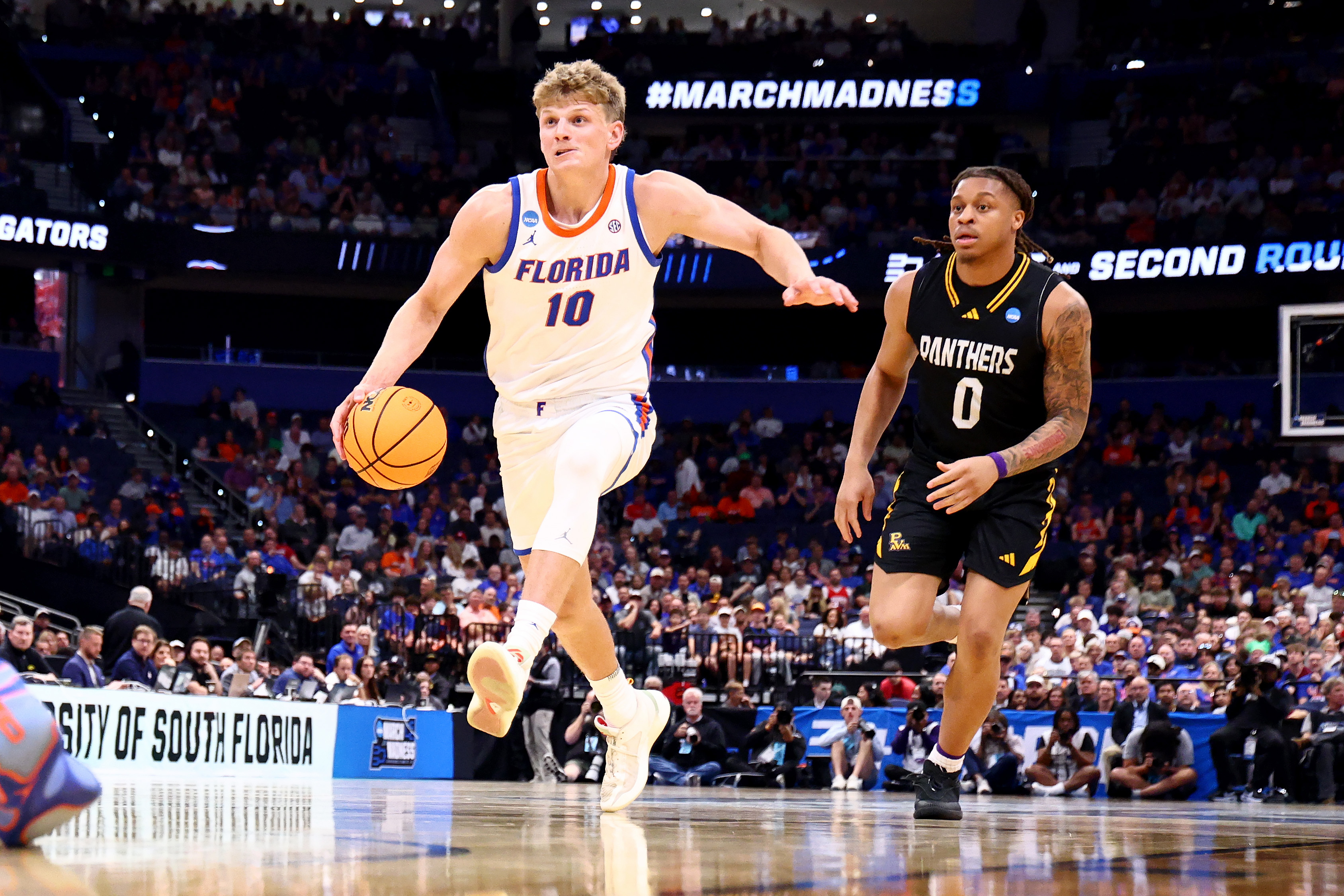
No. 1 Florida records largest March Madness blowout since 1963 with 59-point demolition of No. 16 Prairie View A&M

In a Friday slate ofMarch Madnessgames that went chalk to the extreme, No. 1 Florida's dominance still stood out.

Yahoo Sports

TheGators crushed No. 16 seed Prairie View A&M by the score of 114-55to open their NCAA tournament campaign. At 59 points, that's the second-largest margin of victory in March Madness history, and you have to go back six decades to find the largest.

Draft your Yahoo Fantasy Baseball team for the 2026 MLB Season

One of the Gators' more enormous fans approved.

The record-holder remains Loyola Chicago's 111-42 win over Tennessee Tech (69 points) in 1963, the tournament in which the Ramblers won a championship with a ground-breaking all-Black lineup.

Advertisement

Funnily enough, Prairie View A&M was on the bad end of the previous second-largest blowout, a 110-52 loss to Kansas (58 points) in 1998.

Florida's historic win was actually close for the first seven minutes or so. Prairie View, which reached the game by defeating Lehigh in the First Four, never led, but it did had the game tied at 15-15 at one point in the first half. However, there were signs that one team might have had the upper hand.

Florida then scored the next 18 points and went on a 45-6 run overall to close the first half.

The second half saw the Gators coast to a widely expected victory, never leading by fewer than 38 points. Their largest lead was 63.

None of this was exactly surprising, asFlorida entered the game as the biggest favorite in a March Madness game since 1999.

No. 1 Florida records largest March Madness blowout since 1963 with 59-point demolition of No. 16 Prairie View A&M

In a Friday slate ofMarch Madnessgames that went chalk to the extreme, No. 1 Florida's dominance still stood out. ...


MON SEVEN © 2015 | Distributed By My Blogger Themes | Designed By Templateism.com